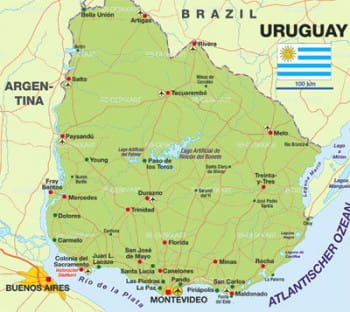
Uruguay: The Country of Tannat
First produced in the Madiran region in the foothills of the Pyrenees Mountains in France, Tannat has a rich and storied history, having been used in the 17th and 18th centuries as payment for taxes.
The Tannat grape was introduced into Uruguay in 1870 by Basque immigrants and has transformed itself into the "national variety", adapting itself perfectly to the local soil and climate.
Considered an exotic grape variety, demand for Tannat is increasing rapidly. Uruguay is the only country in the world where significant amounts of Tannat are grown, more even than in its native Madiran and Irouléguy in south-west France.
Tannat now represents approximately a third of all wine produced in Uruguay.
While French Tannat is typically blended with Cabernet Sauvignon to lessen the high levels of tannins (in fact, the tannins lead the grape to be named "Tannat"), Uruguayan Tannat is less tannic and contains less alcohol, making for an all-around more enjoyable experience.
Uruguayan Tannats:
- Are rich and robust in taste
- Are powerful without overpowering
- Are dark in colour
- Are lighter-bodied than their French predecessors
- Often have notes of chocolate, black pepper, spice, and blackberry
- Are high in Polyphenols, which are believed to reduce the risk of coronary disease
Red wines made from Tannat are the healthiest wines available due the high content of procyanidins, about 3-4 times more than a good Cabernet Sauvignon, as explained in more detail in Roger Corder’s book The Wine Diet.
For a wine enthusiast, a food and wine pairing of a Tannat wine bottle is ideal with grilled and broiled beef red meats, lamb, chicken, roast duck, game meats and goulashes. In the wine and cheese area, the Tannat wine charm goes with strong, well matured and blue cheeses, like Veined, Parmesan and Blooming Rind Cheese.
As a general tasting note, Tannat red wine is best paired with strongly flavored dishes and the ideal serving temperature for consumption is 18 to 20ºC
Uruguayan Wineries

Casa Filgueira
The excellence of the Filgueira wines starts with the quality of the grape. For this reason, the production comes only from its own vineyard. In any area of the vineyard, the production is of high density, following the most modern world tendencies of production.
The harvesting of the grape is done manually by capable personnel trained by the company. The grape is treated very gently during this process, and the boxes are not completely filled to avoid damaging the grape when the boxes are transported to the winery for processing.
At Filgueira, the winery is at the heart of the vineyard. In less than 30 minutes, the grapes arrive with all its potency from the plant to the winery to be processed.
Winery Filgueira has a French consultant, Pascal Marty, whose responsibilities are the winery, the vineyard, and above all, the art of producing wine.
In the winery, everything is dedicated in obtaining an excellent quality of Fine Wines. It was the first in South America to obtain the ISO Quality Certificate 9001-2000 in all of the production areas: vineyard, winery, administration and sales. It has also the Austrian certification OQS in quality of vineyard, winery and administration.
In February 2005, Vineyard and Winery Filgueira obtained the certification for the System of Environmental Processing ISO 14001:2004, which lists the requirements for a system of environmental control that allow the organization to minimize the impact on the environment. An example is the treatment of all the residual water in oxidation lagoons.
The certification of these International Norms allows Filgueira to have an Integrated System of Quality Control.
Casa Filgueira Wines:
Reinaldo De Lucca
De Lucca
Situated on the Atlantic coast and 35 kilometres inland, the vines of "De Lucca" grow in a natural, unspoiled ecosystem. This small winery set in one of the most ancient viticultural regions of Uruguay, comprises 50 hectares of vineyards.
Following the family wine-growing tradition of many years, the director and winemaker Reinaldo de Lucca farms his vines as naturally as is possible, and keeps his winery as basic as possible. This style of artisan production with strict management that respects the ecosystem makes it possible to obtain grapes of the highest quality for those who truly love genuinely original, living wine.
The Agronomist and Oenologist Reinaldo De Lucca, is one of several great characters of the Uruguayan wine world. "El Tano", as everybody knows him, was one of the leaders in the reconstruction of the wine industry in Uruguay 20 years ago.
De Lucca Wines:
- Sauvignon Blanc Reserve 2008
- Marsanne 2009
- Sauvignon Blanc 2009
- Merlot Reserve 2007
- Rio Colorado Reserve 2006
- Syrah Special Cuvee 2009
- Tannat 2009

Juanicó
One of the biggest wineries in Uruguay, but still a family business, the Juanico winery is reckoned to be the most technically advanced in Uruguay, thanks to its investment in the business and its use of the latest technology.
At present the Juanico winery has a total planted area of 240 hectares, or 575 acres, of its own vineyards.
Juanico uses a cultivation system that respects the environment by using the principles of organic farming, avoiding the use of chemicals, to achieve a natural balance in the ecosystem and thereby reduce human intervention.
The harvest is 100% picked by hand in the early hours of the morning to take advantage of this cool and fresh part of the day.
The selection of grapes is done at the moment of picking, rejecting those bunches and grapes that are not prime quality. In some cases this selection goes through a second process on the sorting table at the winery, just before the grapes pass through the destalking machine.
A high quality strategy, a strong industrial investment through which state of the art winemaking technologies are implemented, allow Juanico to develop unique wines.
Juanicó Wines:

Marichal
For over 70 years, Bodega Marichal has been a family boutique winery. Following the family tradition, as well as using the most modern winemaking techniques, Marichal produces Premium Uruguayan wines.
Their wines are born from grapes that are grown in their own vineyards, located in Etchevarría, Canelones, in the South of Uruguay. These vineyards lie just 25 km away from the sea. Therefore, the weather is warm and sunny at daytime and cool at night. These conditions offer the ideal frame for the vines to obtain their optimum growth and expression.
Marichal approach to working is professionally oriented, implementing state-of-the-art oenological technology, while at the same time treating each barrel and each bottle of wine with extreme care and attention.
The infrastructure of the winery has the basic elements in order to yield different varieties of wine in small volumes, and in this way they achieve the personality that their land offers, which is what defines their identity.
100% handpicked grapes and a small family winery allow Bodega Marichal to obtain every harvest unique handcrafted wines.
Listen to Juan Andres, the winemaker in this interview recorded in Bordeaux, France, 2009
Marichal Wines:
- Reserve Collection Pinot Noir Tannat 2007
- Reserve Collection Tannat 2007
- Grand Reserve “A” Tannat 2005