Browse categories
Previously viewed
You haven't yet viewed any products on our store. If you've been here before, you may need to sign in.
Uruguay: Small Production, Global Ambition
Uruguay is quietly establishing itself as one of the most exciting wine-producing countries in the world. Fresh investment is flowing into vineyards and wineries, while long-established producers are finally receiving the international recognition they deserve.
Uruguay is the fourth-largest wine producer in South America, following Argentina, Chile, and Brazil. While its total output is modest by global standards, production reached 67 million litres in 2024, reinforcing the country’s focus on quality over volume.
For context, regional production figures in 2024 were:
-
Argentina: 10.9 million hectolitres (5th largest producer globally)
-
Chile: 9.3 million hectolitres
-
Brazil: 2.3 million hectolitres
Uruguay’s comparatively small scale allows for a more hands-on, artisanal approach, where attention to detail and vineyard expression take priority.
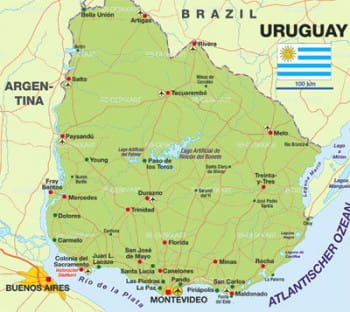
Geographically, Uruguay is similar in size to the US state of Washington (around 176,000 km²), yet its population is just over 3 million, roughly comparable to Wales. This combination of scale, climate, and low production underpins the country’s distinctive wine identity.
Climate, Latitude, and Style
Uruguay’s quality advantage lies in its climate and soils, which produce wines markedly different from those of its neighbours. The prevailing style is more European in character: fresher, more restrained, lower in alcohol, with higher natural acidity and structured tannins rather than ripe, jammy fruit.
The country’s vineyards sit around the 34th parallel south, sharing latitude with Santiago, Mendoza, Stellenbosch, and the Barossa Valley. However, Uruguay’s strong Atlantic influence gives its wines a distinct identity within this global wine belt.
Landscape and Soils
Uruguay is a predominantly flat country, shaped by long-term erosion rather than dramatic geological events. There are no mountain ranges or volcanic formations; the highest point reaches just 514 metres above sea level.
In the key wine-growing zones, soils are typically a mix of alluvial clays, silts, sand, and gravel, often resting on limestone bedrock. These soils help regulate vine vigour and retain moisture during drier periods, contributing to balanced ripening.
Atlantic Influence and Maritime Freshness
Proximity to the Atlantic Ocean defines Uruguay’s climate. Cool Antarctic currents and frequent coastal winds create a cool maritime environment in the south, moderating temperatures and extending the growing season. Further north, conditions become warmer and almost subtropical.
This maritime influence is often compared to Bordeaux or Margaret River, helping to explain Uruguay’s emphasis on freshness, elegance, and structure.
Canelones: The Heart of Uruguayan Wine
The Canelones region is the heart of Uruguay’s wine industry, accounting for around 80% of total production. Located around the capital, Montevideo, and bordering the Río de la Plata — the world’s widest river and a vast estuary opening into the Atlantic — the region benefits from strong maritime moderation.
Vineyards here lie on gently undulating land, rarely rising above 100 metres, with no steep slopes or river valleys. Dominant clay and clay-limestone soils retain water efficiently, meaning irrigation is rarely needed and vines experience minimal water stress, even in warmer years.
